How Vocabulary Is Tested on the SAT and ACT and Why It Matters

When families think about SAT® and ACT® prep, they usually picture math formulas or grammar rules.
Vocabulary rarely makes the list.
That’s a mistake.
The SAT and ACT do not include traditional “define this word” vocabulary questions anymore. But vocabulary is tested constantly. It shows up in reading passages, answer choices, science charts, and even math word problems.
If a student struggles with vocabulary, their score ceiling drops. Not because they lack intelligence. Because they lack access to meaning.
Let’s break down exactly how vocabulary appears on both exams.
How Vocabulary Is Tested on the SAT
The SAT no longer asks students to memorize obscure dictionary definitions. Instead, vocabulary is tested in context.
1. Words in Context Questions
These questions ask:
“Which choice completes the text with the most logical and precise word or phrase?”
One of the answer choices might be “temper.” The challenge is not knowing every definition of “temper.” It’s understanding which definition fits the passage.
Students must:
-
Understand tone
-
Understand surrounding sentences
-
Eliminate plausible but incorrect meanings
This requires real vocabulary depth, not surface familiarity.
2. Advanced Academic Language in Reading Passages
SAT reading passages often include:
-
Historical texts
-
Scientific articles
-
Social science arguments
Even if a question is not directly about a word, comprehension depends on understanding words like:
-
mitigate
-
provisional
-
empirical
-
infer
-
advocate
-
constrain
Miss the meaning of key words and the entire paragraph collapses.
3. Answer Choices That Sound Similar
SAT answer choices are deliberately precise. The difference between:
-
cautious
-
skeptical
-
dismissive
-
indifferent
is subtle. Students with stronger vocabulary can detect nuance. Students without it guess.
How Vocabulary Is Tested on the ACT
The ACT works differently, but vocabulary still drives performance.
1. Reading Section Precision
ACT reading passages move quickly. Students must process meaning fast.
If a student pauses to decode multiple unfamiliar words, timing suffers. Comprehension drops. Accuracy falls.
Vocabulary equals speed.
2. English Section Word Choice
ACT English includes questions that test diction and tone.
Students must choose the word that best fits the context. That means understanding subtle differences between:
-
economical vs. economic
-
imply vs. infer
-
affect vs. effect
Vocabulary knowledge directly impacts grammar performance.
3. Science Section Terminology
The ACT Science section uses scientific language. Even though outside knowledge is not required, vocabulary still matters.
Words like:
-
correlate
-
fluctuate
-
hypothesis
-
variable
-
proportion
appear constantly.
Students who know these words move efficiently. Students who do not waste time decoding.
The Real Role of Vocabulary
Vocabulary is not about memorizing rare words.
It is about:
-
Reading comprehension
-
Speed of processing
-
Understanding nuance
-
Eliminating wrong answers
-
Confidence under time pressure
A limited vocabulary creates friction. Every passage feels harder. Every question feels heavier.
A strong vocabulary creates leverage. Students move faster and with more certainty.
Why Vocabulary Development Must Be Consistent
Vocabulary growth does not happen in one weekend.
It builds through:
-
Repetition
-
Context exposure
-
Active recall
-
Daily engagement
Five minutes a day compounds.
Over weeks, students begin recognizing patterns. Over months, reading becomes easier. Over time, scores rise.
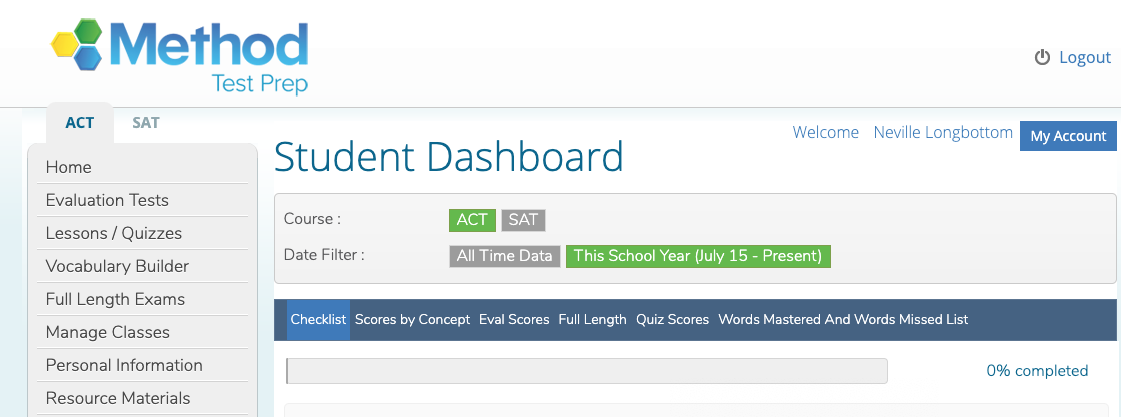
Introducing Our Free Vocabulary Builder
To support this foundational skill, we’ve launched a free Vocabulary Builder designed specifically for high school students preparing for the SAT and ACT.
It focuses on:
-
High-impact academic words
-
Test-relevant vocabulary
-
Short, consistent practice
-
Long-term retention
No fluff. No filler. Just the words that matter.
If you want to raise reading scores, strengthen comprehension, and build real academic confidence, start with vocabulary.
It is the hidden lever most students ignore.
And it may be the difference between a good score and a great one.