
The Most Important Admissions Document You’ve Never Seen

Choosing your high school courses for next year can feel like a high-stakes puzzle. Should you take AP Biology or Honors Anatomy? Is it better to stick with the safe A in a standard course or push for the B+ in a more rigorous elective?
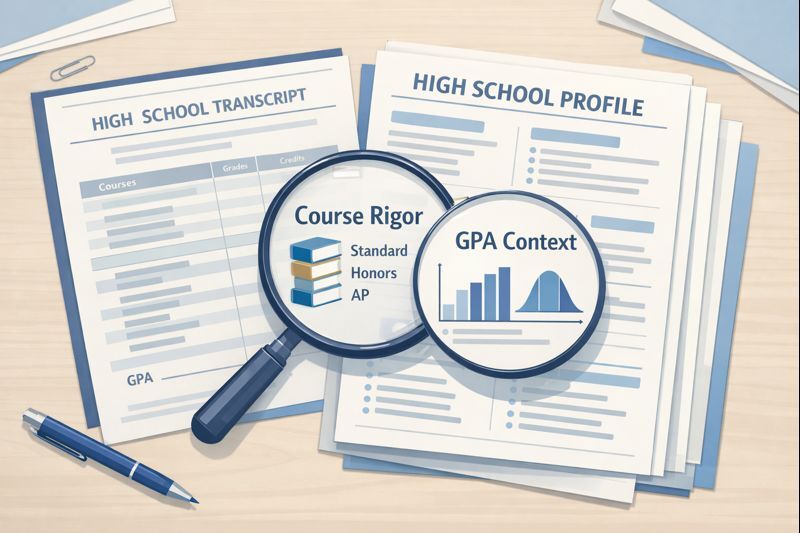
At Method Learning, we know how overwhelming these choices can feel when you are looking at them alone. It is helpful to remember that your transcript is never viewed in isolation. Instead, admissions officers use the High School Profile as a roadmap to ensure they are judging your grades fairly and accurately within the unique context of your high school environment. This document is the key that unlocks the true meaning of your transcript.
The Big Three: Why Rigor Rules the Day
Before we dive into the details of the profile, let’s ground ourselves in what actually moves the needle. Data from the National Association for College Admission Counseling (NACAC) consistently shows that three factors consistently outweigh almost everything else in the admissions process:
- Grades in all courses.
- Grades in college-prep courses.
- Strength of curriculum (rigor).
Admissions officers need to know that you can handle the academic intensity of their campus. However, they are also committed to fairness. They know it isn’t your fault if your school doesn't offer 30 Advanced Placement (AP) courses or an International Baccalaureate (IB) diploma.
This is where the high school profile comes in. It provides the context that allows an officer to judge you fairly against the opportunities available to you, rather than against a student from a different state or a different type of school.
What Exactly is a High School Profile?
Think of the high school profile as a report card for your school itself. It is a multi-page document usually found on your school’s counseling website that tells a college everything they need to know about your academic environment.
What’s Inside?
- Course Offerings: A list of every Honors, AP, IB, and Dual Enrollment course the school provides.
- Grading Scale: Does your school use a 4.0 scale, a 100-point scale, or weighted rankings?
- GPA Distribution: This is a crucial chart showing what percentage of the senior class falls into specific GPA brackets. It tells an admissions officer if a 3.8 is average at your school or if it puts you in the top 5%.
- Test Score Averages: The mean SAT and ACT scores for the graduating class.
- College Matriculation: A list of where previous graduates have enrolled, which signals the track record of the school.
When we work with students at Method Learning, the high school profile is the first thing we look at. We use it to perform a gap analysis. We ask: What is the most rigorous path this school offers, and how close is the student to that path?
The Advisor’s Perspective: A Story of Two Students
I once worked with two students from very different environments. Let’s call them Sarah and Marcus.
Sarah attended a massive suburban high school that offered 28 different AP courses. She was taking three APs and earning straight As. On paper, she looked great. However, when we looked at her high school profile, it revealed that the most competitive students at her school typically took five or six APs by their junior year. In the context of her school, her rigor was actually considered mid-range.
Marcus, on the other hand, went to a small rural school that only offered three AP courses in total: AP English, AP Calculus, and AP U.S. History. Marcus took all three and earned Bs.
To an outsider, Sarah’s transcript looked better. But to an admissions officer, Marcus was the standout. Why? Because the high school profile showed that Marcus had maxed out his curriculum. He took 100% of the rigor available to him. Sarah, meanwhile, had opted for a comfortable path.
The Lesson: Colleges don’t expect you to take courses that don't exist. They expect you to challenge yourself within the framework of what does exist.
How to Use the Profile for Course Selection
As you look toward next year, don’t just pick classes based on what your friends are taking. Go to your high school’s website, search for School Profile, and download the PDF. Use it to guide your decisions in three specific ways:
1. Identify the Next Level
Look at the list of advanced courses. If you are currently in Standard English but the profile shows your school offers Honors and AP tracks, the admissions officer will see that you stayed in the lower lane. If you are capable of the jump, taking that Honors course is a clear signal of growth.
2. Understand Your GPA Context
If your school’s profile shows a heavy weighting system (e.g., adding 1.0 to an AP grade), keep in mind that many selective colleges will unweight your GPA to a standard 4.0 scale to compare you with others. Focus on the grade and the rigor first; don't rely on a weighted number to hide a lack of challenge.
3. Check for Hidden Opportunities
Sometimes a profile reveals specialized tracks, like a Dual Enrollment partnership with a local community college or a specific STEM certification. If you are aiming for a specific major, these extra rigorous options listed on the profile can make you stand out from peers who are just following the standard AP track.
The Insider Tip: The Local Competition
Here is a reality that many families find surprising: in the initial rounds of application review, you are often competing more with the students in your own hallways than with students across the country.
Admissions officers are typically assigned to specific geographic territories. The person reading your application is likely the same person reading the applications of your classmates. They will have your high school profile sitting right next to your file.
If they see five applicants from your school, and four of them took AP Physics while you took an easier elective, they will notice. The high school profile makes it impossible to hide a soft schedule. This is why we encourage Method Learning students to think strategically. You want your transcript to tell a story of a student who looked at the available opportunities and said, "I want to be challenged."
Partnering for Success
Navigating the nuances of rigor and context is exactly what we do best. At Method Learning, we don't just help you get better grades; we help you understand the admissions rubric so you can make informed, empowered choices.
When we sit down for a planning session, we treat the high school profile as our roadmap. We want to ensure that when an admissions officer looks at your context, they see a student who has seized every opportunity.
Before you turn in your course selection sheet for next year, take ten minutes to find your school profile. Look at it through the eyes of an admissions officer. Does your proposed schedule reflect the best version of your academic self? If you aren't sure, we are here to help you bridge that gap.
We'd like to help you draft a specific list of questions to ask your school counselor about how your specific course selections compare to the most rigorous path on your school's profile. Contact us today.
.png)


